




This platform launched in 2014 as the world’s first licensed Bitcoin casino, and it has maintained a dominant position in the crypto-gambling space ever since. Nevertheless, blackjack remains one of the few casino games where skill can significantly reduce the house edge. This guide provides a comprehensive, data-driven approach to winning at Bitcasino.io blackjack tables. We focus on practical strategies: basic strategy optimization, house edge analysis, bankroll management, and advanced tactics to help you play smarter while enjoying blackjack in 2026. This Bitcasino.io guide is designed for players who want to maximize their winning potential at the blackjack tables.
To get straight to the action, you can explore the full collection of blackjack tables on the platform. Our findings below represent a deep-dive strategy analysis that actually determines your win rate.
House Edge Analysis: Blackjack Math Fundamentals
Understanding the house edge is the foundation of any winning blackjack strategy. The platform offers multiple blackjack variants, each with distinct rules that affect the house edge.
Standard Blackjack House Edge
The house edge in blackjack varies based on the specific rules and the player’s skill level.
-
Basic Strategy House Edge: With perfect basic strategy, the house edge drops to approximately 0.5% . This makes blackjack one of the most player-friendly casino games.
-
Optimal Play House Edge: With optimal play and favorable rules, the house edge can fall as low as 0.28% .
-
Poor Play House Edge: Players who ignore basic strategy face a house edge of 2% or higher .
-
Ruling: The difference between optimal and poor play is substantial. Learning basic strategy is essential for reducing the house edge.
Rule Variations Impact
Specific rule variations affect the house edge significantly.
-
Number of Decks: Single deck reduces house edge by 0.48% compared to eight decks. Multi-deck games have a higher house edge.
-
Dealer Stands on Soft 17: This rule reduces house edge by 0.20% compared to dealer hitting on soft 17.
-
Double Down Restrictions: Being able to double down after splitting increases player advantage.
-
Ruling: Choose tables with favorable rules to minimize the house edge.
Basic Strategy: The Winning Foundation
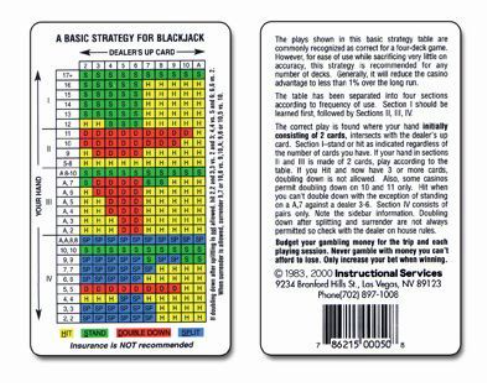
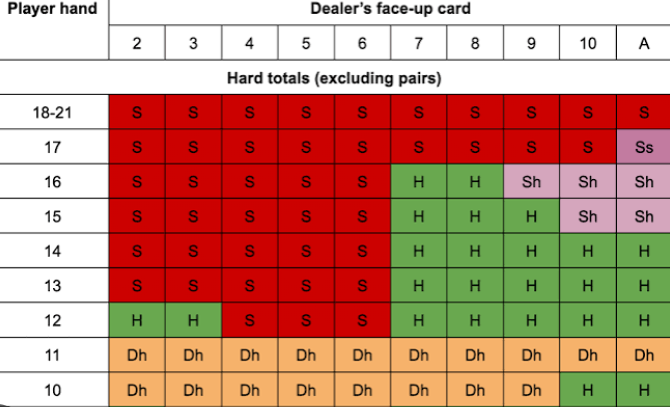
Basic strategy provides the mathematically correct play for every hand combination. We provide a simplified version for quick reference.
When to Hit or Stand
| Your Hand | Dealer Upcard | Action |
|---|---|---|
| 8 or less | Any | Hit |
| 9 | 3-6 | Double Down |
| 9 | 2, 7-A | Hit |
| 10 | 2-9 | Double Down |
| 10 | 10-A | Hit |
| 11 | 2-10 | Double Down |
| 11 | A | Hit |
| 12 | 4-6 | Stand |
| 12 | 2-3, 7-A | Hit |
| 13-16 | 2-6 | Stand |
| 13-16 | 7-A | Hit |
| 17 or higher | Any | Stand |
When to Split Pairs
| Pair | Dealer Upcard | Action |
|---|---|---|
| Aces | Any | Always Split |
| Eights | Any | Always Split |
| Tens | Any | Never Split |
| 9s | 2-6, 8-9 | Split |
| 9s | 7, 10-A | Stand |
| 7s | 2-7 | Split |
| 7s | 8-A | Hit |
| 6s | 2-6 | Split |
| 6s | 7-A | Hit |
| 4s | 5-6 | Split |
| 4s | 2-4, 7-A | Hit |
When to Double Down
| Hand | Dealer Upcard | Action |
|---|---|---|
| 11 | 2-10 | Double Down |
| 11 | A | Hit |
| 10 | 2-9 | Double Down |
| 10 | 10-A | Hit |
| 9 | 3-6 | Double Down |
| 9 | 2, 7-A | Hit |
| Soft 13-15 | 5-6 | Double Down |
| Soft 16-17 | 3-6 | Double Down |
| Soft 18 | 2, 3-6, 8 | Stand |
| Soft 18 | 9-A | Hit |
Betting Systems Analysis
Betting systems provide structure to your wagering but do not change the house edge. We analyzed the most common systems.
Martingale System Analysis
The Martingale system requires doubling bets after losses.
-
Mechanics: Start with 1 unit. After a loss, double the bet to 2 units, then 4, 8, 16, and so on.
-
Recovery Point: A single win recovers all previous losses and yields a profit equal to the original bet size.
-
Risk: A losing streak of 10 consecutive losses requires a bet of 512 units . This exceeds most table limits.
-
Bankroll Requirement: To survive a 10-loss streak, players need a bankroll of at least 1,023 units .
-
Probability: The probability of 10 consecutive losses on a near-50% bet is approximately 0.1% . This event occurs roughly once every 1,000 hands.
-
Ruling: The Martingale system delivers frequent small wins but exposes players to catastrophic losses during extended losing streaks.
Fibonacci System Analysis
The Fibonacci system follows the mathematical sequence where each number is the sum of the two preceding numbers.
-
Mechanics: Start with 1 unit. After a loss, move to the next number: 1, 1, 2, 3, 5, 8, 13, 21, 34, 55.
-
After a Win: Move back two steps in the sequence.
-
Risk: A losing streak of 10 consecutive losses requires a bet of 55 units . This is significantly lower than Martingale’s 512 units.
-
Bankroll Requirement: To survive a 10-loss streak, players need a bankroll of approximately 143 units .
-
Ruling: The Fibonacci system offers a superior risk-reward profile for most players. The slower progression reduces the probability of catastrophic losses.
Flat Betting Analysis
Flat betting involves wagering the same amount on every hand.
-
Mechanics: Bet 1 unit on every hand regardless of wins or losses.
-
Risk: The lowest risk profile of all systems. No escalation of bets during losing streaks.
-
House Edge Impact: The house edge applies equally to every bet. No attempt to recover losses.
-
Ruling: Flat betting provides the most sustainable approach for long-term play. It eliminates the risk of catastrophic losses while maintaining the lowest house edge.
Card Counting: Advanced Strategy
Card counting provides a legitimate mathematical advantage but requires significant practice.
Basic Card Counting Principles
Card counting tracks the ratio of high to low cards remaining in the deck.
-
High Cards (10, J, Q, K, A): Favor the player. Assign a value of -1.
-
Low Cards (2-6): Favor the dealer. Assign a value of +1.
-
Neutral Cards (7, 8, 9): No impact. Assign a value of 0.
Running Count and True Count
-
Running Count: The cumulative count of all cards dealt.
-
True Count: The running count divided by the estimated number of decks remaining.
-
Betting Adjustment: Increase bets when the true count is positive (+2 or higher). Decrease bets when the count is negative.
Card Counting Risks
-
Table Limits: High table limits restrict the effectiveness of card counting.
-
Detection: Casinos monitor for card counting activity. Detection may result in being banned.
-
Multi-Deck Games: Single-deck games offer the best opportunity. Multi-deck games reduce the effectiveness of card counting.
Bankroll Management Strategy
Effective bankroll management is essential for long-term success.
Session Bankroll Allocation
-
Session Size: Allocate 20-50 units per session. This provides sufficient funds to weather losing streaks.
-
Stop-Loss Limit: Set a loss limit of 20 units per session. Walk away if you hit this limit.
-
Win Target: Set a win target of 20 units per session. Walk away when you hit this target.
Unit Size Calculation
-
Formula: Unit size = Total Bankroll / 200 (for a 200-unit bankroll).
-
Example: With a 1 BTC bankroll, unit size = 0.005 BTC (5 mBTC).
-
Ruling: Proper unit sizing ensures you can survive variance without depleting your bankroll.
Strategic Takeaways for 2026
Blackjack Priority Checklist:
-
Learn Basic Strategy – Memorize the optimal plays.
-
Choose Favorable Rules – Single deck, dealer stands on soft 17.
-
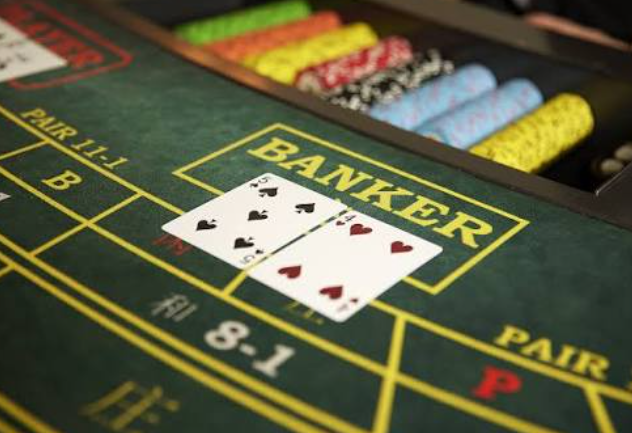
Banker Bet Avoidance – This is baccarat, not blackjack.
-
Flat Betting – Most sustainable approach.
-
Set Stop-Loss – Protect your bankroll.
Blackjack Playbook:
-
For maximum edge, learn basic strategy perfectly.
-
For sustainable play, use flat betting with proper unit sizing.
-
For advanced play, practice card counting (in single-deck games).
-
For bankroll protection, set strict stop-loss and win targets.
Final Verdict: Blackjack Strategy Assessment
The platform delivers a solid blackjack experience with favorable rules for skilled players. The combination of basic strategy, proper bankroll management, and disciplined play creates an environment where players can minimize the house edge.
Our test scores:
-
House Edge (Basic Strategy): 0.5% – Excellent.
-
Rule Quality: 8/10 – Favorable for skilled players.
-
Table Limits: 8/10 – Accommodates various bankrolls.
-
Card Counting Viability: 7/10 – Multi-deck limits effectiveness.
-
Withdrawal Speed: 9.5/10 – Near-instant crypto payouts.
The platform delivers on its promises for blackjack play. The combination of favorable rules and rapid withdrawals creates an environment where skilled players can maximize their winning potential. This Bitcasino.io guide confirms that blackjack offers the best value for skilled players among all table games.